
When Do You Need a Real Estate Attorney in California?
California does not require an attorney to close a real estate transaction. Escrow officers handle the paperwork. Agents guide the negotiation. Title companies process the transfer. For a straightforward deal between willing parties, that system works. But when something goes wrong, or when the deal itself is structurally complex, the absence of an attorney at the table can cost far more than the legal fees you were trying to avoid.
The question isn’t whether you can complete a transaction without an attorney. The question is whether you can afford the risk of doing so.
Here’s a practical guide to some of the specific moments in a California real estate transaction or dispute where legal counsel shifts from optional to essential.
California Closes Differently Than Most States
In many states, attorneys are required to attend the closing table. California is not one of them. Here, escrow companies perform much of the work that attorneys handle elsewhere, and that creates a gap most buyers and sellers don’t see until they’re already in it.
Escrow officers are neutral parties. They follow instructions. They do not review your purchase agreement for legal exposure, advise you on whether a contingency protects you, or flag contract language that may waive your rights. That is legal work, and it falls outside what escrow is permitted to do.
If your transaction is clean and simple, the gap may never matter. But if you’re purchasing a property with a complicated title history, negotiating a commercial lease, or dealing with a dispute between co-owners, you need someone in your corner who is actually reading for legal risk, not just processing documents.

Title Defects and Disputes
Title problems are more common than buyers expect, and California’s layered ownership history creates plenty of opportunities for them. A title search may surface an old lien that was never properly released, an easement that was recorded decades ago but never disclosed, or a gap in the chain of ownership that creates genuine uncertainty about who holds legal title.
Title insurance can protect you against certain defects, but it doesn’t resolve them. When a title defect surfaces before or after closing, an attorney steps in to do the actual legal work: filing quiet title actions, negotiating with lienholders, interpreting recorded easements, or working with the title company on curative measures. These are not tasks an escrow officer or agent can handle.
If your transaction involves a title dispute, don’t wait to see if it resolves on its own. Title defects that go unaddressed can cloud ownership for years and complicate any future sale or refinancing.
When the Purchase Agreement Becomes a Dispute
The purchase agreement is a legally binding contract. Most buyers treat it like a formality, but its language determines what happens if a deal falls apart, who keeps the deposit, and whether either party can sue for damages.
California’s standard residential purchase agreement includes a liquidated damages clause and a dispute resolution clause that defaults to arbitration. If you sign without understanding what those provisions mean, you may waive your right to a jury trial or limit your recovery before the transaction even closes. An attorney reviewing the contract before you sign is not excessive caution, it’s basic protection.
For buyers, the most critical window is before you remove contingencies. Once inspection, appraisal, and financing contingencies are released, your deposit is at risk if you back out. If the seller has breached the agreement, or if material information was withheld, you need an attorney evaluating your options before you act. Our team handles real estate disputes and litigation for exactly these situations, from pre-litigation negotiations to trial.
Alt text: California real estate attorney reviewing a commercial lease agreement with a business owner in a modern conference room, pointing to key contract clauses alongside architectural plans and business documents.
Commercial Leases and Investment Transactions
If you’re leasing commercial space for your business, or purchasing an investment property with tenants in place, the legal stakes are higher than a standard residential transaction and the documentation reflects it. Commercial leases in California are extensive, with provisions on personal guarantees, rent escalation, tenant improvement allowances, assignment rights, and early termination penalties that vary significantly from one landlord’s form to the next.
Unlike residential leases, commercial leases carry no automatic consumer protections. What the contract says is almost always what a court will enforce. Signing a commercial lease without an attorney review means accepting whatever the landlord’s form says, and those forms are drafted in the landlord’s best interest.
For investment property purchases, an attorney experienced in purchase and sale transactions helps you understand what you’re actually buying: the rent roll, existing leases, CAM charges, estoppel certificates, and any encumbrances that survive the sale. These details don’t always take focus until they generate losses.
You can review the basics of what real estate attorneys do in California through the California Department of Real Estate’s consumer resources, which outline the roles of escrow, agents, and other transaction participants.
1031 Exchanges and Complex Ownership Structures
A 1031 exchange lets you defer capital gains taxes on the sale of investment property by rolling proceeds into a like-kind replacement property. The tax benefit is significant. The legal requirements are precise. Miss a deadline, misidentify a replacement property, or fail to use a qualified intermediary correctly, and the entire exchange fails. The IRS provides 1031 exchange guidance to outline the mechanics, but structuring the transaction correctly requires legal and tax counsel working together.
Beyond 1031s, many investment properties are held in LLCs or other entities that add complexity to both acquisition and disposition. If you’re buying into a partnership, inheriting a property with multiple heirs, or acquiring a property with an LLC interest transfer rather than a deed transfer, the transaction needs legal review. Ownership structure affects liability exposure, financing options, and tax treatment, and getting it wrong at the start creates problems that are expensive to untangle later.
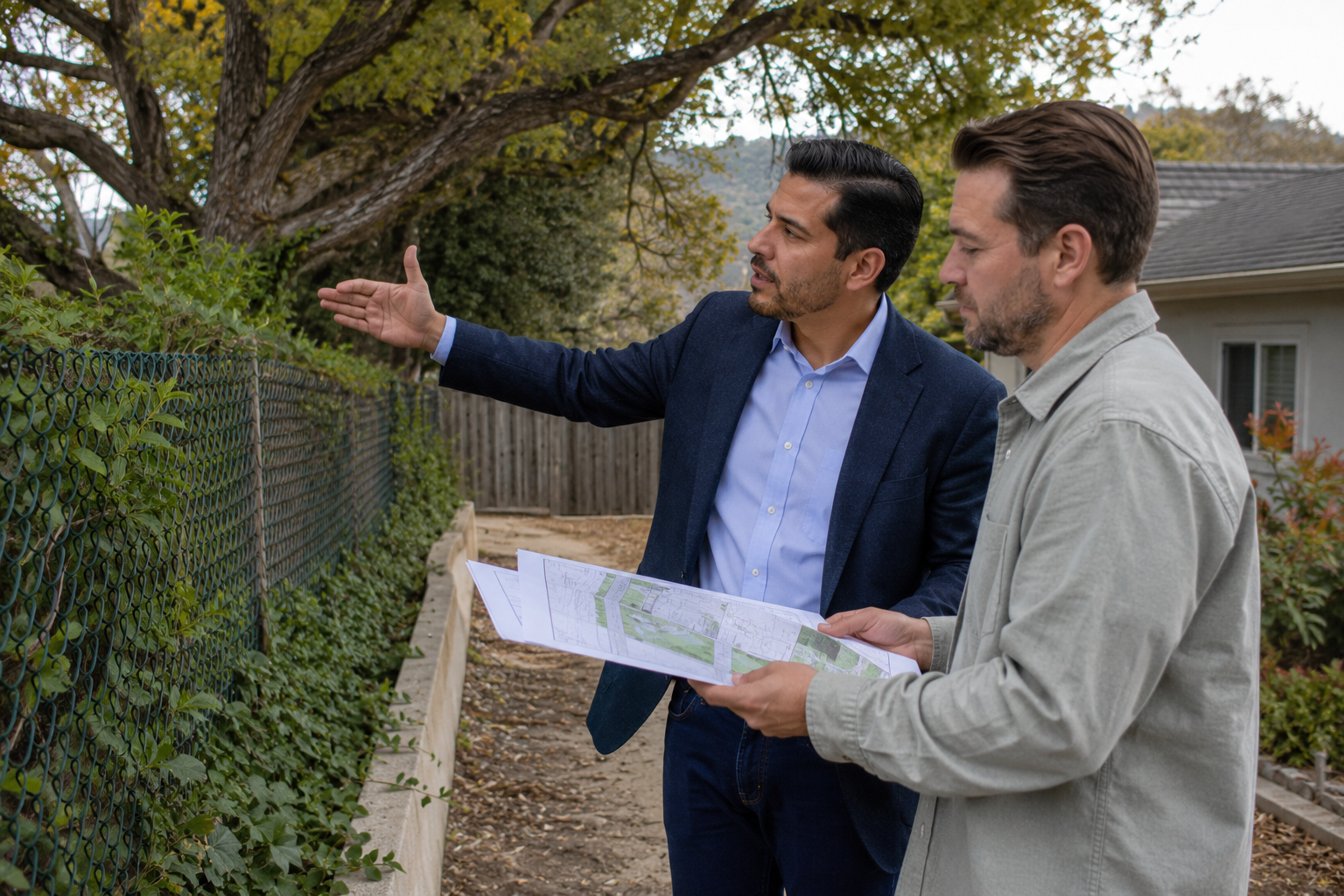
Alt text: California real estate attorney reviewing a property survey map with a homeowner while discussing residential property boundaries beside a fence in a suburban neighborhood.

Boundary Disputes and Easement Conflicts
California property records carry decades, sometimes over a century, of recorded easements, access agreements, and boundary descriptions that don’t always match what’s physically on the ground. Neighbors disagree about where a property line actually runs. An easement for utilities or access that was recorded in 1962 suddenly becomes relevant when someone starts construction. A shared driveway arrangement that worked for years becomes a legal fight when the property changes hands.
These disputes require someone who can read survey maps, interpret recorded documents, and assess your legal position accurately before you invest money in a conflict that may or may not be worth pursuing. Boundary and easement litigation requires case-specific analysis from an attorney familiar with California property law.
If you’re purchasing property adjacent to a boundary you’re not certain about, get an attorney’s assessment before closing, not after.
The Right Time to Call Is Before Things Go Wrong
Most clients call us after a problem has already developed. That works, and we handle disputes at every stage. But the clients who come out in the strongest position are usually the ones who brought us in early: before signing the purchase agreement, before entering a commercial lease, before releasing contingencies, before the 1031 exchange clock started running.
If your transaction is straightforward and both parties are operating in good faith, you may get through it without legal counsel and never feel the gap. But if complexity exists, or if something feels off, the cost of a consultation is small compared to the cost of finding out later that you had fewer protections than you assumed.
For specific questions about your transaction or an existing dispute, review our commercial leases and real estate law services or contact our team directly. DMAB Law has served San Diego area clients for more than two decades, with a team that handles real estate matters at every level of complexity, from straightforward purchases to contested litigation.
To get started, schedule a free initial consultation with our team. You’re also welcome to read what past clients have said about working with DMAB Law on Google before you reach out.