

What Is Insurance Bad Faith Litigation and When Can You Sue?
California law gives policyholders real remedies when an insurer unreasonably denies, delays, or underpays a valid claim.
Under the right circumstances, you can recover consequential damages, attorney’s fees, and potentially punitive damages well above the policy limits. This post explains how California’s bad faith doctrine works, when it applies specifically to title insurance and commercial property claims, and generally what facts you need to support a viable case.
Alt text: A person’s hands hold an insurance claim denial letter beside an open insurance policy document and a pen on a desk.
What Bad Faith Actually Means Under California Law
Insurance bad faith is not just a dissatisfied policyholder’s way of saying the insurer got it wrong. It’s a recognized legal cause of action with specific elements, and California courts have defined it precisely.
Every insurance policy carries an implied covenant of good faith and fair dealing. That covenant is read into every California insurance contract automatically, without any explicit language requiring it. When an insurer breaches that covenant, the insured has a cause of action for bad faith in addition to any breach of contract claim.
The legal standard California courts apply is whether the insurer’s conduct was unreasonable. This doesn’t require proof that the insurer acted maliciously or fraudulently. If the insurer had no legitimate basis for its coverage position, or if it failed to conduct an adequate investigation before denying the claim, that can be enough to cross the line. The California Department of Insurance has also established specific fair claims settlement regulations that codify what prompt and proper claims handling looks like, and violations of those regulations are frequently cited as evidence of bad faith conduct.
The Brandt Rule: Why Attorney’s Fees Are a Separate Recoverable Damage
One of the most important remedies in a California bad faith case comes from a 1985 California Supreme Court decision, Brandt v. Superior Court. The rule from that case is straightforward: when an insurer tortiously withholds policy benefits, the insured can recover the attorney’s fees incurred to obtain those benefits as a separate element of damages.
This matters because in most American litigation, each side pays its own attorneys. The Brandt rule creates a meaningful exception for insurance bad faith claims. If your insurer wrongfully denied a claim and you had to hire an attorney to force payment, the cost of that attorney is part of your damages. That changes the economics of the dispute significantly, especially for policyholders who might otherwise decide the legal fight isn’t worth the cost.
Brandt fees are calculated based on the portion of your attorney’s time that can be attributed to obtaining policy benefits, not time spent on the bad faith claim itself. An experienced California attorney will track time with that allocation in mind from the start of the case.

How Bad Faith Applies to Title Insurance Claims
Title insurance disputes are a specific and frequently litigated category of bad faith claims in California. A title policy is supposed to protect you against ownership defects, liens, encumbrances, and other title problems that existed before you purchased the property and weren’t disclosed. When a title insurer improperly denies coverage for a valid claim, or drags out its investigation without justification, the bad faith doctrine applies just as it does with any other type of insurance.
At DMAB, our firm’s title insurance litigation practice has handled these disputes from both sides. Common fact patterns that support a bad faith claim against a title insurer include: coverage denials based on policy exclusions that don’t actually apply to the claimed loss, failure to conduct a timely or adequate investigation of the claim, lowball offers to settle a title defect at a fraction of the actual loss, and failure to provide a timely written denial with the specific basis for the coverage position.
California Insurance Code section 790.03 and the accompanying regulations set out specific timelines for acknowledging, investigating, and resolving claims. A title insurer that sits on a claim for months without substantive activity is not just being slow, it may be accumulating evidence of bad faith.
If you have a disputed title claim, explore your options with our title disputes litigation team before accepting a denial as the final answer.
Alt text: Four attorneys in business attire sit around a conference table reviewing documents together in a law office.
Bad Faith in Commercial Property and Business Interruption Claims
Commercial property owners and tenants can also face bad faith conduct involving property damage, business interruption, and liability claims. Disputes often arise when insurers delay investigations, undervalue losses, rely on questionable expert opinions, or deny coverage without adequately reviewing the facts.
California law may allow businesses to recover consequential damages caused by an insurer’s unreasonable delay or denial. For example, delayed payment could leave a business unable to replace inventory, continue construction, make mortgage payments, or resume normal operations. In some cases, these losses can exceed the value of the original insurance claim.
For business owners facing a coverage dispute, our civil litigation and disputes team handles complex commercial insurance matters throughout Southern California.
The Facts That Build a Bad Faith Case
Building a viable case requires specific, documented evidence of unreasonable insurer conduct. If the insurer had a genuine, reasonable basis for denying or limiting the claim, even if that position turns out to be wrong, that generally won’t support a bad faith verdict.
What you need are facts showing the insurer’s conduct was objectively unreasonable. The evidence that matters most tends to fall into a few categories.
Written Denial Letters With No Adequate Basis
A denial letter that cites an exclusion without actually analyzing how that exclusion applies to your specific facts is a strong starting point. California insurers are required to provide written denials that specifically identify the basis for the coverage position. A letter that simply quotes policy language without connecting it to the facts of your claim is both a regulatory violation and evidence of inadequate investigation.
Delayed Investigations Without Justification
California regulations require insurers to acknowledge a claim promptly, begin investigation immediately, and accept or deny within specific timeframes. Delays measured in months, with no substantive activity and no written updates, are often the clearest evidence of bad faith. Document every contact you have with your insurer, every deadline that passes without response, and every request for documentation that goes unanswered.
Lowball Valuations and Settlement Offers
When an insurer retains an expert who produces a loss estimate far below your own documented losses, and that estimate can’t be reconciled with the actual evidence, that’s a fact pattern courts take seriously. The key is documentation. Your own independent valuation, contractor estimates, appraisals, and business records all become critical evidence when the insurer’s offer is disconnected from reality.
The Insurer’s Internal Communications
Discovery in bad faith litigation often reveals internal emails, claims adjuster notes, and supervisor approvals that show the insurer knew its coverage position was questionable. California courts allow broad discovery into insurer claims files and internal communications in bad faith cases, and those materials frequently tell the story that no denial letter ever would.
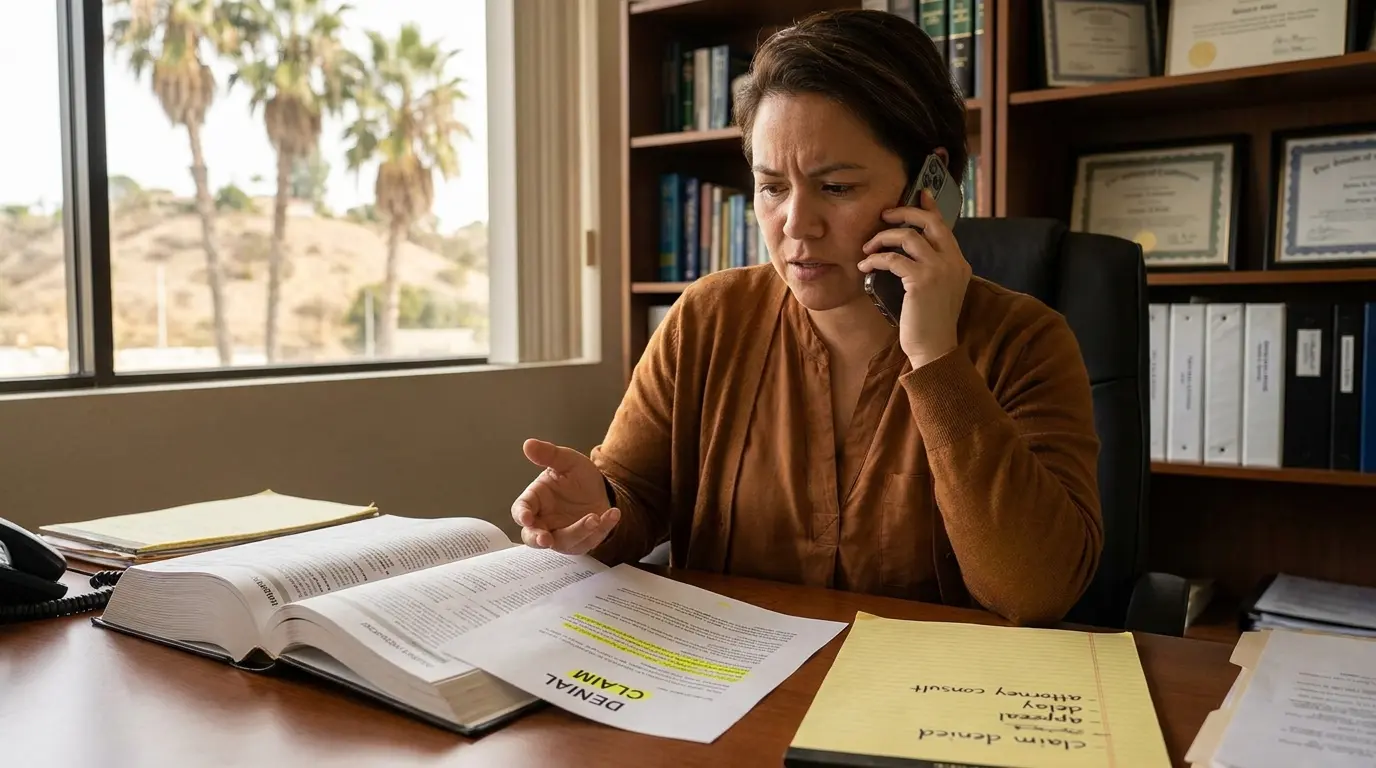
Alt text: An attorney sits at her desk on the phone, reviewing a legal pad and a claim denial document, with palm trees visible through the office window.
What You Can Recover Beyond Policy Benefits
California gives bad faith plaintiffs a broader range of remedies than most states. Beyond recovering the policy benefits wrongfully withheld, you may be entitled to consequential damages caused by the insurer’s delay or denial, attorney’s fees under the Brandt rule, emotional distress damages in some cases, and punitive damages if the insurer’s conduct was oppressive, fraudulent, or malicious.
Punitive damages in insurance bad faith cases can be substantial. California Civil Code section 3294 allows courts to award punitive damages when the defendant acted with malice, oppression, or fraud. Insurers that have a pattern of similar misconduct, or whose internal documents show conscious disregard for policyholders’ rights, face real punitive exposure. The National Association of Insurance Commissioners publishes resources on policyholder rights that provide useful context for understanding what proper claims handling should look like.
When to Talk to an Attorney
The short answer is: as soon as you suspect the insurer’s conduct is unreasonable. Once you settle a claim, you typically release all related claims, including any bad faith claim you might have had. Waiting to consult counsel until after you’ve signed a release is one of the most common and costly mistakes policyholders make.
If your claim has been denied, delayed more than a few weeks without explanation, or settled with a number that doesn’t reflect your actual loss, those are the trigger points for a legal consultation.
Our real estate disputes and litigation team and our title insurance group both handle insurance bad faith matters for property owners, developers, and business clients throughout San Diego and Southern California. If you believe you may be experiencing unreasonable insurer conduct, contact our Carlsbad office to schedule your initial consultation.